


Anatomy of a Fountain Pen
A fountain pen looks simple from the outside, but every line you write depends on a handful of carefully made parts working together. Knowing what each one is called makes it easier to choose the right nib, look after your pen and, if you ever need our help, describe exactly what is going on.
Every Tom Hessin fountain pen is a cartridge/converter pen, so the anatomy below applies across the Charles, Revolution, Rebel, Edinburgh and Magnetic collections. Where a collection does something differently, we have said so.
The cap
The cap protects the nib and, just as importantly, stops the ink at the tip from drying out between uses.
- Cap
- The outer sleeve that covers the nib and closes onto the pen. You can also rest it on the end of the barrel while you write, known as posting, if you prefer a longer pen.
- Finial
- The very top of the cap. On most pens it is where the clip is anchored, and it is often finished as a decorative detail.
- Clip
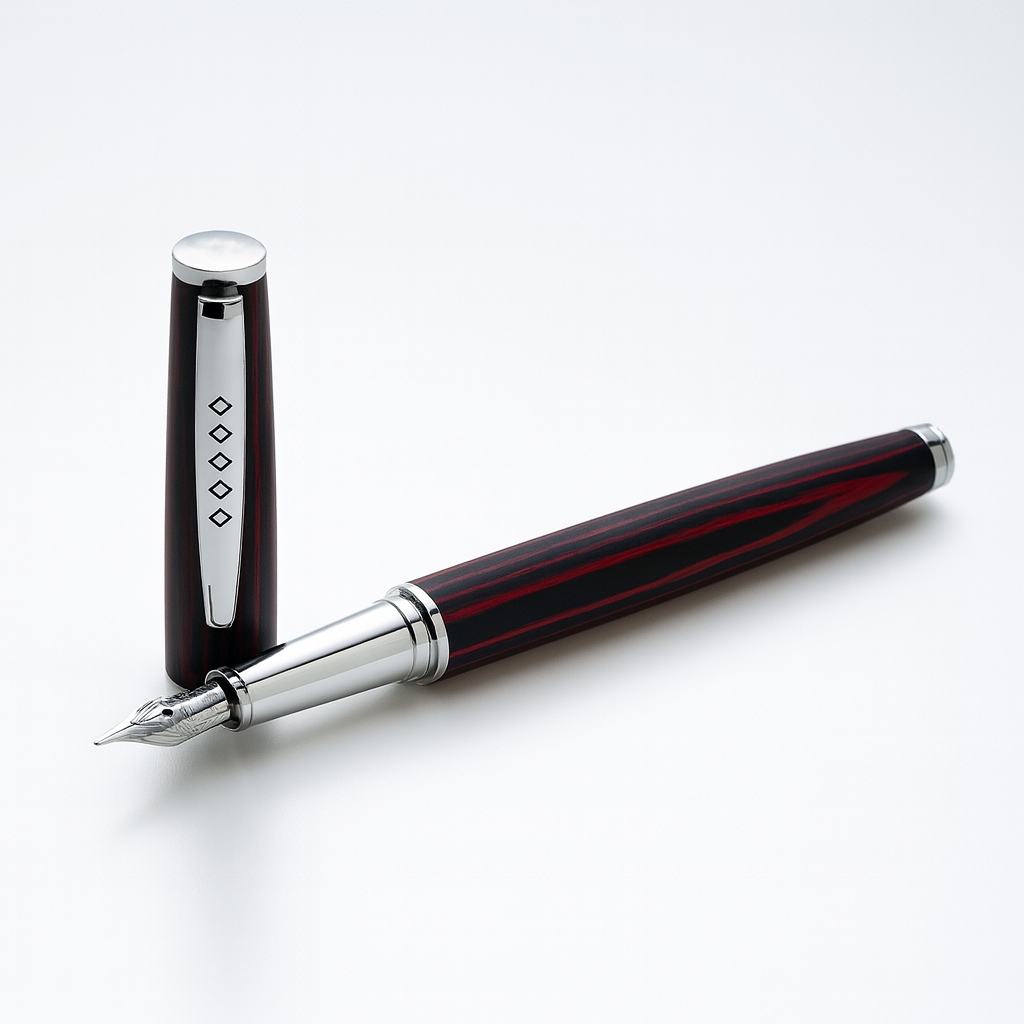
- Keeps the pen secure in a pocket, notebook or pen loop, and stops it rolling off the desk. Every Tom Hessin clip carries our five-diamond legacy detail, one diamond for each generation of the family.
- Inner cap
- A liner inside the cap that closes around the section when the pen is capped, creating a small sealed chamber so the nib stays ready to write.
- Centre band
- The metal ring at the open end of the cap. It adds a finishing detail and reinforces the part of the cap that takes the most wear.
- Lip
- The open end of the cap, which meets the barrel when the pen is closed.
The barrel
The barrel is the main body of the pen, and the part you will recognise each collection by, from the ebony and walnut of the Revolution to the lacquered finishes of the Rebel.
- Barrel
- The long body of the pen that houses the cartridge or converter. On our wooden pens it is made from real wood, so the grain of every pen is slightly different.
- Barrel threads
- The spiral grooves inside the open end of the barrel that let it screw onto the section. This is where you unscrew the pen to change a cartridge or fill the converter.
- Decorative band
- A metal band or ring on the barrel. On the Revolution collection it is the double ring that deliberately breaks up the wood grain.
- End cap
- The closed end of the barrel, sometimes finished with a metal detail. The Revolution Palace Gates edition carries the Hessin bird here.
The section
The section sits between the nib and the barrel. It is where your fingers rest as you write, and it holds the nib and feed in place.
- Section (grip)
- The shaped front part of the pen that you hold. Its length, diameter and material all affect how comfortable a pen feels over a long writing session.
- Section threads
- The threaded rear end of the section that screws into the barrel.
- Cartridge post
- The small tube at the back of the section. A cartridge or converter pushes onto it, and it is the route ink takes from the reservoir into the feed.
The nib
The nib is the heart of a fountain pen. It is the only part that touches the paper, and it decides how your writing looks and feels.
- Nib
- The shaped metal point that delivers ink to the page. Tom Hessin nibs are made by JoWo in Germany: a size #5 on the Revolution, Rebel and Edinburgh collections, and a larger #6 on the Charles collection.
- Tipping
- A tiny bead of very hard metal alloy welded to the end of the nib and ground to shape. It is the part that actually glides across the paper, and its size is what makes a nib write extra fine, fine, medium or broad. It is often called iridium, after the metal traditionally used for the job.
- Tines
- The two halves of the nib on either side of the slit. They meet at the tipping and spread very slightly under pressure. Flex nibs, available on the Charles collection, are designed to spread much further for expressive thick-and-thin lines.
- Slit
- The fine cut down the centre of the nib. Ink travels along it by capillary action, from the feed to the tip.
- Breather hole
- The small hole at the end of the slit. It relieves stress in the metal where the slit ends, making the nib more resilient and giving the tines a little more give.
- Shoulders
- The widest part of the nib, where it begins to taper towards the tip.
- Imprint
- The design and markings stamped or engraved on the face of the nib.
- Nib finish
- Nibs are either polished steel or coated. The Revolution, Rebel and Magnetic Carbon pens have PVD-coated nibs. PVD (physical vapour deposition) bonds a thin, hard-wearing finish to the steel so the nib matches the pen's trim.
Not sure which nib size suits your handwriting? See our Nib Size Guide.
The feed
If the nib is the heart of the pen, the feed is its circulation. It sits directly under the nib and controls how much ink reaches the tip: enough for a smooth, consistent line, but not so much that the pen blots.
- Feed
- The ridged piece, usually black, beneath the nib. It carries ink forward from the cartridge or converter and lets air travel back to replace it. That steady exchange of ink out and air in is what keeps a fountain pen writing evenly.
- Ink channel
- A very narrow groove along the top of the feed, directly beneath the nib slit. Capillary action draws ink along it to the tip.
- Fins
- The thin combs cut into the feed. They hold a small reserve of ink, which helps the pen cope with fast writing and with changes in temperature or air pressure without blotting.
Cartridges & converters
Every Tom Hessin fountain pen comes with both an ink cartridge and a converter, so you can choose between convenience and a wider choice of ink.
- Cartridge
- A sealed, disposable tube of ink. Pushing it onto the cartridge post pierces the seal and the pen is ready to write. Quick, clean and ideal when you are out and about.
- Converter
- A refillable reservoir that fits in place of a cartridge, so you can fill your pen from a bottle and use any fountain pen ink you like.
- Mouth
- The open end of the converter, which pushes onto the cartridge post.
- Reservoir
- The chamber that holds the ink.
- Piston seal
- The plunger inside the reservoir. As it moves back it creates suction and draws ink up through the nib and feed.
- Rod
- The threaded shaft that connects the piston seal to the knob.
- Shroud
- The metal collar that holds the piston mechanism onto the reservoir.
- Knob
- The end you turn to move the piston: one way to draw ink in, the other to push it out.
Ready to fill your pen? Our step-by-step filling guide covers cartridges, converters and bottled ink.
Keep every part in good order.
A little regular care keeps your pen writing beautifully for years. Read our Pen Care guide, or if something is not quite right, get in touch with our team.