



How to Fill a Fountain Pen
Every Tom Hessin fountain pen arrives ready for two ways of filling: an ink cartridge for instant, mess-free writing, and a converter so you can fill from a bottle of ink. This guide walks you through both, how to flush your pen when you change colour, and what to do if the ink is not flowing as it should.
New to the parts of a pen? Our Anatomy of a Fountain Pen guide explains every term used below.
Cartridge or converter?
There is no right answer. Many people keep a cartridge in the pen for everyday use and switch to the converter when they want to try a new colour.
| Cartridge | Converter | |
|---|---|---|
| Best for | Convenience, travel and first-time fountain pen users | Choosing your own ink from a bottle |
| How it works | Pre-filled and sealed. Push it on and write. | A small piston draws ink up from a bottle |
| Ink choice | Limited to the cartridges available | Any ink made for fountain pens |
| Mess | None | A little. Keep a tissue handy. |
| In the box | Yes | Yes |
Fitting an ink cartridge
- Hold the pen with the nib pointing up and unscrew the barrel from the section.
- If a converter or an empty cartridge is fitted, pull it straight off the cartridge post. Avoid rocking it from side to side.
- Push the new cartridge, narrow end first, firmly onto the cartridge post. It needs a firm press: you will feel it give as the seal inside is pierced. Hold the section, not the nib, while you do this.
- Screw the barrel back on.
- Give the ink a moment to travel through the feed. Resting the pen nib-down for a minute or two usually does it. Then write a few small circles on scrap paper until the line runs smoothly.
Filling a converter from a bottle
- Unscrew the barrel. If a cartridge is fitted, pull it off and push the converter firmly onto the cartridge post.
- Turn the knob on the end of the converter until the piston reaches the nib end. This pushes out the air.
- Dip the nib into the ink until the whole nib, including the breather hole, is below the surface.
- Slowly turn the knob the other way. The piston draws ink up through the nib and feed into the converter.
- A converter rarely fills completely first time. For a fuller fill, lift the pen out and hold it nib-up, turn the knob to push out the air bubble until a drop of ink appears at the nib, then dip it back in and draw ink up again.
- Lift the pen out of the bottle, wipe the nib, feed and section with a lint-free tissue, and screw the barrel back on.
Changing ink & flushing your pen
Flush your pen whenever you change ink colour, if it has been left unused for a few weeks, or every couple of months as routine care. Clean water is all you need.
- Unscrew the barrel and remove the cartridge or converter. Only the nib and section need cleaning, so keep wooden and lacquered barrels away from water.
- Rinse the nib and section under cool or lukewarm running water. Never use hot water.
- If you use a converter, fit it and draw up clean water, then push it back out. Repeat until the water runs clear.
- For stubborn dried ink, stand the nib and section in a glass of cool water overnight, then rinse again.
- Blot with a soft, lint-free cloth, then leave the nib and section nib-down on a folded tissue to draw out the last of the water before refilling.
Avoid alcohol, solvents and household cleaners. They can damage the feed, seals and finishes. For more on looking after your pen, see our Pen Care guide.
Choosing an ink
Use only inks made for fountain pens. India ink, drawing ink and calligraphy inks that are not labelled as fountain pen safe contain binders or pigments that can clog the feed for good. Do not mix different inks in the pen; flush it out before changing brand or colour.
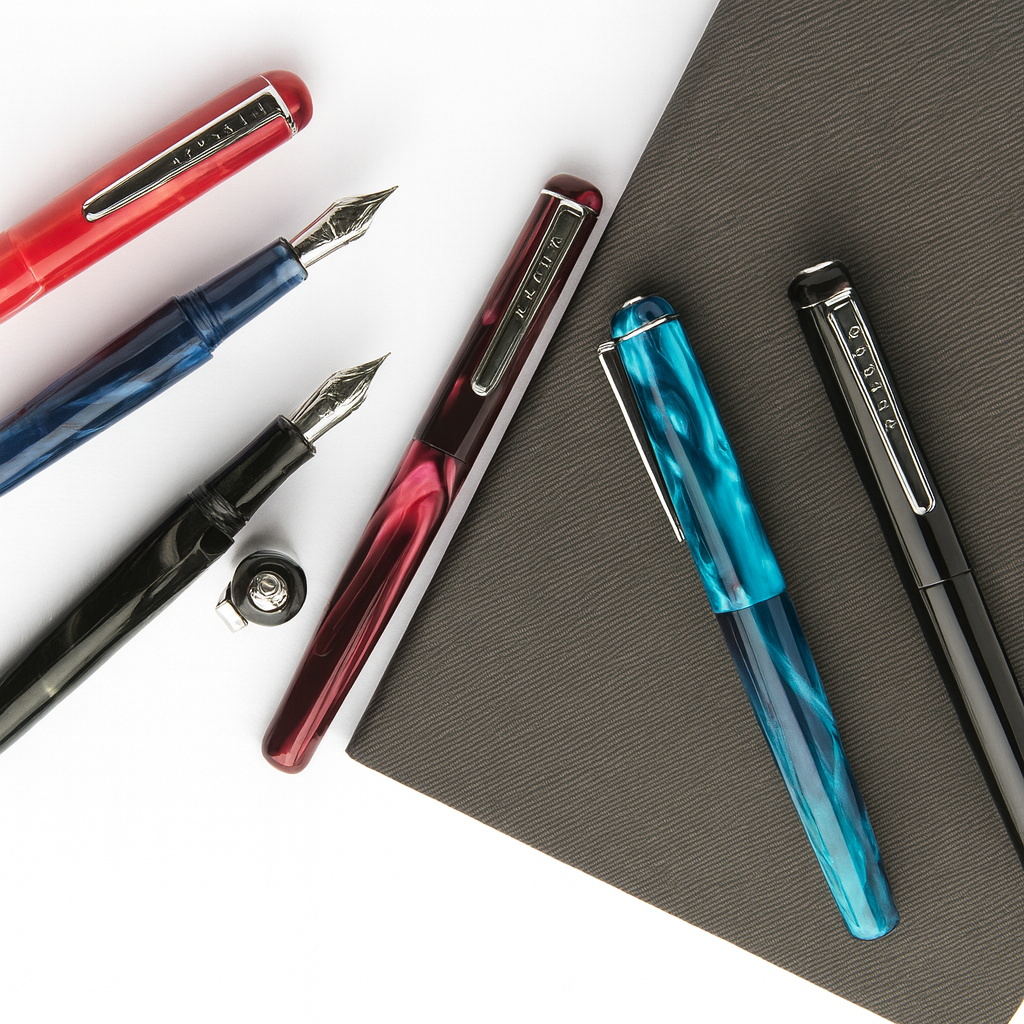
Our own Tom Hessin inks come in four colours, each named after a pen in the Charles collection: Signature Blue, Birmingham Noir, Highland Green and Exhibition Red.
Troubleshooting
- I have fitted a new cartridge but no ink is coming through.
- The cartridge may not be pushed fully home, so the seal has not been pierced. Remove the barrel and press it on more firmly. If it is seated, give the ink a few minutes to reach the nib, resting the pen nib-down.
- The pen skips or is slow to start.
- Ink may have dried at the tip, especially if the pen was left uncapped. Dip the nib in water for a few seconds, or flush the pen if it keeps happening. If you use a converter, turn the knob gently until a drop of ink appears at the nib to push ink back into the feed.
- The line is too wet or the pen blots.
- An over-full converter warmed by your hand can push out too much ink. Turn the knob back slightly to release a drop into a tissue. Store the pen nib-up when you are not using it.
- There is ink inside the cap.
- A little is normal, particularly after travelling or being carried nib-down. Wipe the cap and section clean. If it keeps happening, flush the pen and get in touch.
- The nib feels scratchy or the line has suddenly changed.
- The nib may have been dropped or knocked out of alignment. Please do not try to bend it back. Contact our team. Your pen is covered by the Tom Hessin Guarantee, and replacement nib sections are available.
Travelling with your fountain pen
Changes in air pressure on a flight can push ink out of the nib. Before you fly, either fill the pen completely, so there is little air inside to expand, or empty it. Keep the pen capped and carry it nib-up in your hand luggage, and open it over a tissue when you land.
Need a hand?
If your pen is not writing as it should, our team is happy to help. Get in touch, or choose a new nib size with our Nib Size Guide.